Last Updated: September 10, 2026
Table of Contents
Beyond Fungal Infections: Other Scalp Conditions You Should Know About
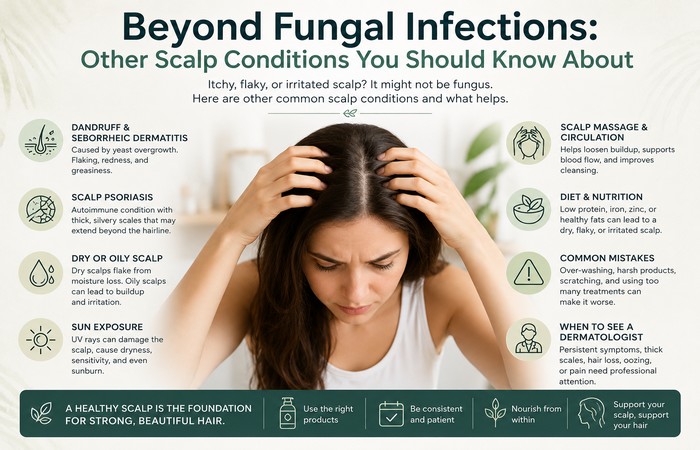
It’s not always fungal irritation of your scalp that makes it feel tight, dry, or peeling. So many people figure flaking is equal to fungal-induced dandruff, when in reality there are many different causes of scalping and you often end up buying many ineffective solutions while working your way toward the right cause and solution.
this article belongs to general health
Dandruff and Seborrheic Dermatitis
Basically, dandruff and seborrheic dermatitis occur along the same range, and most skin doctor actually think of dandruff as the most benign form of seborrheic dermatitis anyway. Both seem to be associated with a natural yeast that occurs on everybody’s skin called Malassezia, which is only problematic when it gets out of control. Essentially, it feeds on scalp oils and causes inflammation. Pure dandruff just means there are dry-looking flakes on your head; there’s no significant redness or swelling.
With seborrheic dermatitis, there are red or discoloured swollen areas on the scalp as well as the characteristic flaky bits. The scale feels slightly greasy, and various factors like climate (cold weather aggravates them and is likely the cause of flaking in winter), hormonal changes, stress, and even certain diseases can contribute.
Thankfully, there is treatment available that benefits both conditions. Look for products that contain selenium sulfidic, zinc pyridine, ketoconazole, or salicylic acid-these work by inhibiting yeast growth or by regulating normal skin cell shedding and buildup. Ketoconazole shampoo treatment, while on the shelf is considered a proven treatment for those with seborrheic dermatitis and even for those suffering with a slightly worse case than dandruff alone (because these products aren’t strictly prescribed, just approved for use for dandruff.) If the over the counter treatment options aren’t clearing your issue after a few weeks you can turn to a dermatologist for some stronger treatments.
To understand how this fits into the broader picture, explore our Comprehensive Healthy Hair Pillar.
Scalp Psoriasis: Not the Same Thing as Dandruff
The constantly being confused is very often scalp psoriasis. That’s a very easy error as you have flaky skin in both conditions as well as itching. The differences really do come down to the scale. In psoriasis you’ll often see thick, dry and more silver/white scales that spread outside the hairline onto the forehead, neck or back of your ears. Seb derm and dandruff flakes tend to be more watery and thinner. The key that psoriasis and seb derm differ is that psoriasis is caused by an autoimmune disease rather than a yeast or fungus so it is not likely to be contagious, can run in families and occur in conjunction with psoriasis elsewhere in your body, also often harder to clear than common dandruff.
Having both is in fact not uncommon and that’s called Sebo psoriasis by derms and can be the real tricky one that needs a physical exam to accurately diagnose. If dandruff shampoo isn’t clearing it in a couple of weeks or the scales feel “dry and thick” then they may not lift off the way simple dandruff dandruff would.
When your scalp feels irritated, it doesn’t automatically mean you have a medical condition; often, it’s simply because your habits aren’t aligned with your scalp’s individual oil production level. Flaky skin that itches can look like dandruff, but those scales are usually finer and drier and don’t have the yeast overgrowth that exacerbates traditional dandruff. Things like strong sulfates in shampoos, over-washing, hot-water showers, or dry winter heating can all exacerbate a dry scalp condition.
Your scalp probably has over-active sebaceous glands that go into overdrive if yours feels oily.
Along with build-up, your hair may feel weighed down day two and three of not washing, and those scales that show up more as oil and dead skin become sticky. The approach to fixing each is pretty much the opposite of the other. You’ll do far better washing an dry scalp less, using lukewarm water, and a gentler, sulfate-free formula than treating it with even more washing, where greasy scalps might respond best to cleansing at the roots more often. This is something that can get neglected when we develop a set, one-size-fits-all weekly washing schedule as opposed to looking to the actual needs of the scalp.
We address how our shampoo frequency helps with how healthy our hair is in detail in our healthy hair guide, which covers washing frequency, conditioning, and scalp care.
You may also find our companion piece on 7 Unhealthy Internet Habits Overview helpful for further context.
Sun Exposure and Scalp Damage
Earlier we mentioned this and will elaborate a bit more here; UV exposure oxidizes the natural oils but also dehydrates the skin barrier leaving the scalp more susceptible to flaking and sensitivity, sunburn can even occur on areas that have lost hair or have a prominent part line. Fair-skinned individuals, those who have thinning hair, and/or a shaved head have the highest risk. Wear a hat with a wide brim (easiest), but scalp SPF sprays are available for extensive outdoor activities like spending a day at the beach.
Scalp Massage and Circulation
Online many people are discussing scalp massage as an effective growth hack-while it won’t magically grant you tresses the length of a medieval maiden’s, there’s certainly some worth to it. A few minutes massaging your scalp by hand (or using a silicone scalp massager as you shampoo) can aid in dislodging residue from products, dry flakes, and loose skin before you thoroughly rinse off your shampoo, thereby improving its efficiency. Several, smaller studies indicate that scalp massage may help to boost circulation to the region to a limited degree – but do not substitute this for actual, professional medical care should you suffer from an ongoing health condition or obviously thinning locks. It is best considered an extra at shower time and not standalone treatment.
Diet’s Role in Scalp Health
Basically your scalp is skin and skin tells you a great deal more about how healthy you are than you’d realize. Low protein, zinc, iron or healthy fatty acid diets all manifest as a dry, flaky or irritated scalp in addition to its effect on the growth of hair. Don’t rush to load up on dozens of supplements-for most the key is just ensuring that their normal diet includes a good dose of protein and vegetables, and healthy fats. Years of dieting and calorie restriction is often one of the biggest culprits, and least suspected.
For related practical techniques, check out our insights in 10 Healthy Habits That Can Help Practical Tips.
Common Mistakes That Make Scalp Problems Worse
Several habits seem to appear repeatedly. Not washing enough accumulates oil, sweat, and products that are not only irritating, but also smelly. Washing too much with harsh sulfate shampoos can remove skin’s protective barrier and trigger the dryness and flaking that one was initially concerned about.
Scratching aggressively when itchy – though an understandable impulse – has the potential to break skin and therefore increase the likelihood of infection.
Applying several “scalp treatment” products all at once without any chance for them to work individually make it difficult to determine what is truly working.
Explore educational health benchmarks through the National Institutes of Health Health Info.
When to See a Dermatologist
With a good shampoo and some time, most scalp irritations can resolve themselves in a few weeks. But if you spot such a telltale sign, it might be time for a trip to the doctor, not just the local pharmacy: continuing and expanding patches; thick, resistant scales; itching coupled with hair loss; oozing or scabbing; or severely pain, not itching; the dermatologist can often identify fungal infections, seborrheic dermatitis, and psoriasis. A lot less guess-work than picking at drugstore sales and solutions. Ultimately the healthiest scalp provides the springboard for healthy shine, softness, length, all. If you’re working on your scalp routine, it’s worth pairing it with good habits for the hair itself too, which is exactly what we cover in our full healthy hair guide.